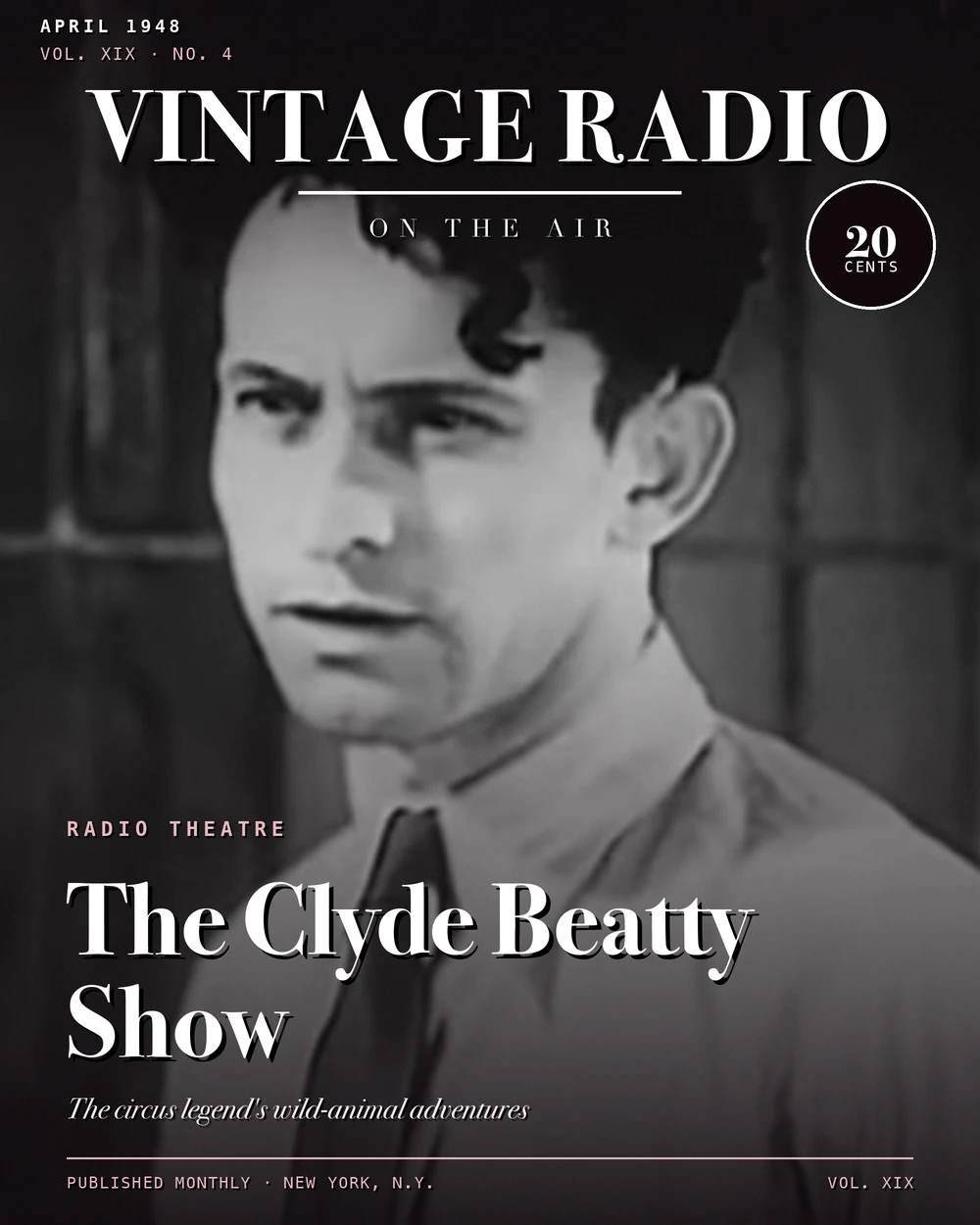
The Clyde Beatty Show
The Man Behind the Microphone
By the time The Clyde Beatty Show made its Mutual network debut on December 11, 1950, Clyde Beatty was already one of the most recognizable names in American entertainment. Born Clyde Raymond Beatty on June 10, 1903, in Bainbridge, Ohio — the eldest of nine children — he had joined Howe's Great London and Van Amburgh's Wild Animal Circus as a cage boy on August 16, 1921, learning the trade under the legendary trainer Louis Roth. His signature "fighting act" had him commanding up to 40 big cats at once — typically 25 lions and 15 tigers — inside a 32-foot-diameter steel cage, working with a chair, a whip, and a pistol loaded with blanks. By the 1930s his popularity with children was compared to that of Gene Autry and Tom Mix, and he had played himself in films including The Big Cage (1933), The Lost Jungle (1934), the 15-episode serial Darkest Africa (1936), and Africa Screams with Abbott and Costello (1949).
How It Got on the Air
The show started with a personal connection. Producer Shirley Thomas brought the idea for a Clyde Beatty radio series to her husband, Walter White Jr., whose Commodore Productions had just come off a major success with Hopalong Cassidy. When Commodore and Artists Inc. announced the project in November 1949, they were explicit about their hopes — they wanted it to be as popular as the Cassidy program. Commodore produced the show as a transcribed syndication and sold it to Mutual with Kellogg's coming on as sponsor.
The Kellogg's connection brought the show squarely into children's adventure territory, with Rice Krispies advertising running throughout, including a jingle tied to the brand's "Snap, Crackle and Pop" characters. Each episode opened with an announcement describing Beatty as "the world's greatest wild animal trainer" and noting that "500 people live as one family" behind the scenes of the Clyde Beatty Circus. The show aired Mondays, Wednesdays, and Fridays at 5:30 — a time slot aimed squarely at the after-school audience.
The Cast and the Complications
The lead role of Clyde Beatty went to Vic Perrin — without on-air credit. Perrin silently impersonated Beatty; audiences heard "Clyde Beatty" and were never told an actor was playing him. A Wisconsin native who had started in broadcasting as a parking-lot attendant at NBC-Hollywood before becoming a staff announcer in 1941, Perrin was a working West Coast radio actor with credits in Dragnet, Escape, Gunsmoke, Fort Laramie, and Yours Truly Johnny Dollar. He would later become widely recognizable as the "Control Voice" narrator of The Outer Limits from 1963 to 1965.
Eve McVeagh played Beatty's wife, Harriet — and here the production faced an uncomfortable reality. The real Harriett Beatty, born Harriett Evans and married to Clyde on September 16, 1933, had died on October 15, 1950, in Kosciusko, Mississippi, from a heart ailment, before the Mutual run even began. Harriett had been an aerialist by trade and had become a wild animal trainer herself after joining Beatty's circus in 1935. Rather than write her out, the producers kept her as a character and framed the stories as having taken place "a few years ago" — a practical solution that also happened to preserve the human core of the show. Writers Frank Hart Taussig and R. T. Smith drew on the couple's real story extensively.
What the Stories Were Made Of
The adventure fiction was grounded in real incidents from Beatty's career, which gave the scripts an authenticity that purely invented material couldn't have matched. "Brush with Death" dramatized his real encounter with the male lion Nero — an attack that put him in the hospital for ten weeks and nearly ended his career. "Beauty and the Beast" drew from his 1941 book Jungle Performers and dramatized how Harriett learned animal training, ending with the true incident of her substituting for a sick Clyde at the Milwaukee Shrine Circus. "Tiger Escape" was based on the actual escape of the tigress Gracie and Beatty's recapture of her inside the half-completed Detroit Shrine Temple hotel. "Crisis on the Set" was loosely drawn from a 1934 incident during filming of The Lost Jungle.
Not every episode stuck to Beatty's own life. At least two scripts drew on the adventures of Frank "Bring 'em Back Alive" Buck, with "Leopard on the Loose" pulling material from Buck's 1930 book. Other episodes sent Beatty and Harriett hunting gorillas in Africa, investigating a reported living unicorn, and facing headhunters in the Amazon. "Daniel in the Lion's Den" is the surviving episode set at Beatty's Clyde Beatty Jungle Zoo in Fort Lauderdale, Florida. The range ran from circus mystery to wilderness expedition — fictionalized, but anchored to real places and real people.
After the Radio Run
The show ran through January 18, 1952, with 52 episodes produced over its Mutual run; Commodore had recorded 156 individual syndicated transcriptions for sale through the end of 1951. When the radio series ended, the company moved its attention toward a Clyde Beatty television program, also beginning in 1952.
Beatty himself kept performing. On The Ed Sullivan Show in 1957, his act went out of control during the live broadcast, and Sullivan improvised by going into the crowd to introduce celebrity attendees while Beatty subdued the lions with blank cartridges. By 1961, his name had become cultural shorthand: in Hatari!, John Wayne's character refers to using a chair on a cheetah as a "Clyde Beatty routine." Director Errol Morris used footage from Beatty's films in his 1997 documentary Fast, Cheap & Out of Control, where lion tamer Dave Hoover cited Beatty as a formative influence. Beatty died on July 19, 1965, of esophageal cancer in Ventura, California, and was interred at Forest Lawn Memorial Park in Hollywood Hills, the plaque on his grave marked with a lion.